
Capstone Phase 5: Production Orchestration with LangGraph
Transitioning from Custom Loops to LangGraph
In the previous phases, we constructed our support agent using basic while-loops and manual conditional logic to route queries to specialized specialists. While this approach works for small prototypes, it quickly becomes unmanageable as system complexity scales. Exposing dozens of tools and workflows within a single custom loop leads to monolithic, nested code blocks that are extremely difficult to inspect, debug, or maintain.
To build production-grade agentic applications, engineers use formal orchestration frameworks like LangGraph. LangGraph models agentic behavior as a state machine (routing graph) structured around three main concepts:
- State: A shared memory schema (typically a TypedDict) that is passed from node to node. Every execution step reads from this state and writes updates back to it.
- Nodes: Standard Python functions that perform discrete units of work, such as calling an LLM, calling a database API, or reading a policy index. Each node receives the current state as input and returns a dictionary updating specific state attributes.
- Edges: The links defining how state flows between nodes. Normal edges connect nodes sequentially, while conditional edges use decision functions to dynamically route execution based on state values.
State Machine Architecture
The LangGraph architecture for our support agent is illustrated below:
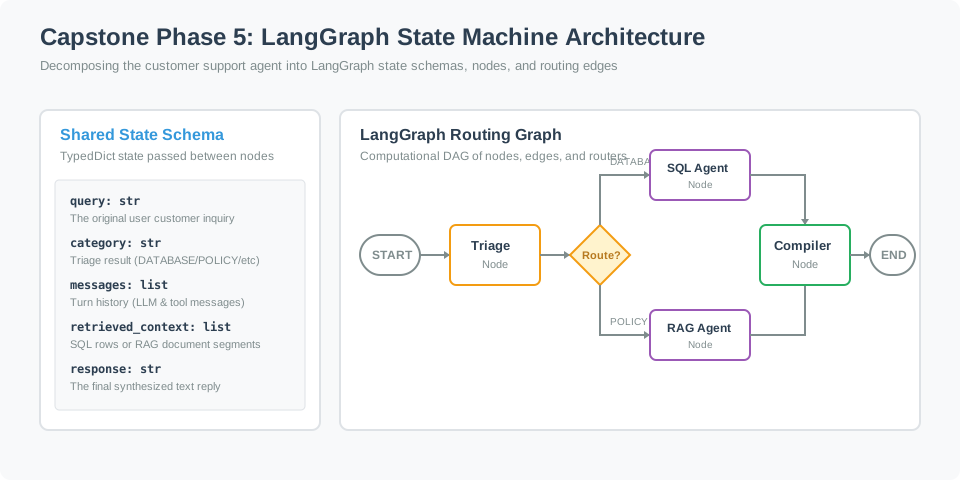

- Shared State Schema: Holds the conversation history, user query, triage category, retrieved API context, and final reply.
- Nodes: The graph entry is routed to the
triageclassifier node, which feeds into a conditional router to execute eitherdb_api_agentorrag_agentspecialist nodes, converging at thecompilerresponse node.
Interactive Playground: LangGraph Implementation
The following diagram illustrates the playground execution flow and state updates as the graph processes a database order query:
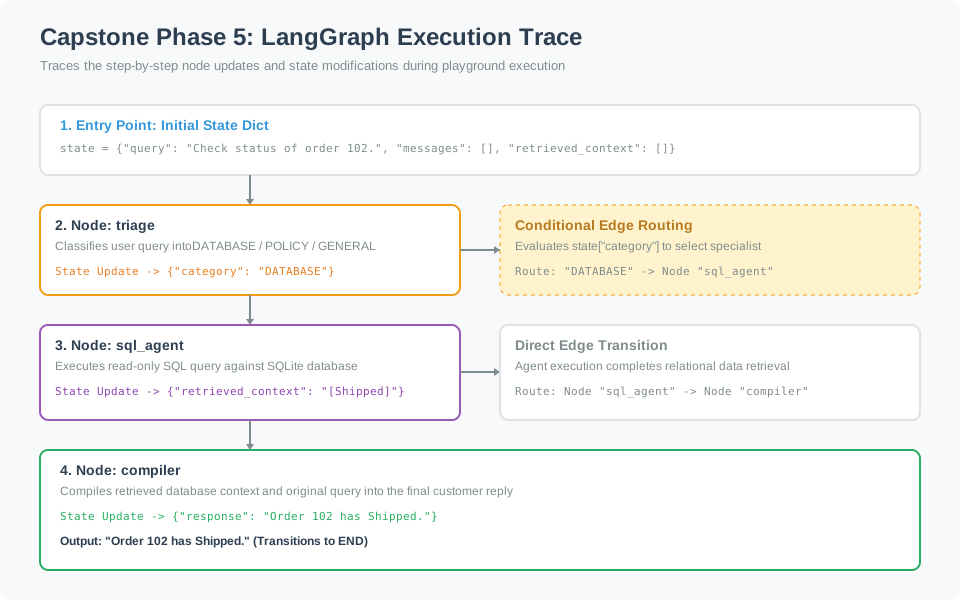
The playground below implements this state graph using a lightweight in-browser simulator. By modeling our agent as a graph, we decouple database API access from policy searches and general chit-chat, ensuring each specialist node remains isolated and focused.
Decoupling complex system states into formal graphs enables clean scaling. Inside each Specialist Node, developers can customize system instructions, prompt formatting, and tool schemas. If business constraints change, updates are isolated to single nodes or graph transition definitions, protecting the remainder of the software architecture from regressions.