
Orchestration Abstractions and Multi-Agent Systems
Beyond Single-Loop Architectures
As system requirements expand, a single autonomous loop managing multiple tools face significant scaling limits. In a single-agent architecture, the system prompt must guide the model through all possible tools, business rules, and conversation paths. This approach introduces structural challenges:
- Context Window Dilution: Bundling every tool schema, system instruction, and validation rule into a single prompt consumes substantial tokens, increasing execution latency and operational cost.
- Attention Degradation: When presented with dozens of tools, models suffer from "lost in the middle" phenomena, occasionally selecting incorrect tools or hallucinating parameters.
- Monolithic State Management: Debugging a monolithic prompt is difficult; optimizing instructions for one scenario often causes regressions in others.
To resolve these issues, complex systems transition to multi-agent architectures. Under this paradigm, tasks are decomposed and routed to a network of specialized, narrow agents. Each agent maintains a minimal prompt context and access to a restricted subset of tools.
Triage Nodes and Routing Graphs
A multi-agent system is structured as a routing graph (or state machine). Instead of allowing arbitrary agent-to-agent transitions, developers define explicit state transitions where each node represents a processing step or an agent execution.
The entry point of this graph is typically a Triage Node. The triage node functions as a classifier: it consumes the user's query, matches it against routing categories, and directs the conversation to the appropriate specialist agent.
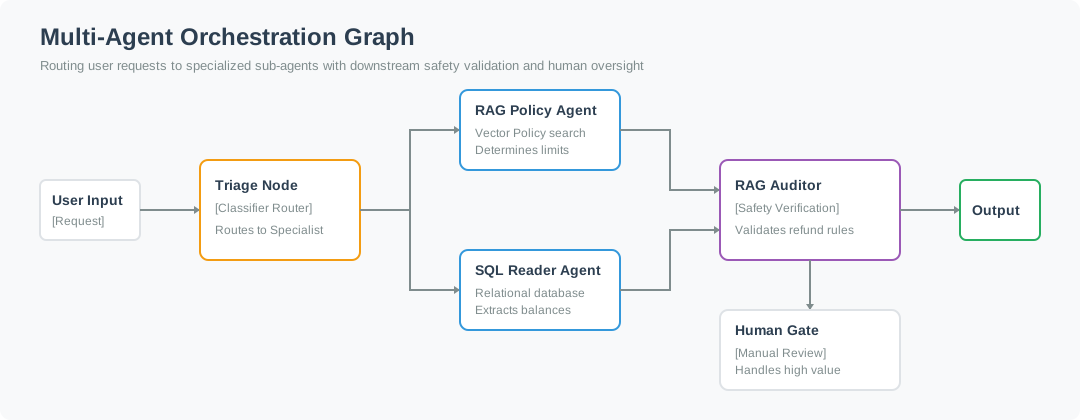

- Triage Router: An LLM or deterministic classifier that matches inputs to specialized sub-agents.
- Specialist Agents: Downstream nodes (such as a SQL Reader Agent or a RAG Policy Agent) that execute specific tasks and return structured responses.
- Auditor Nodes: Deterministic or agentic verification gates that review specialist outputs against safety constraints before finalizing execution.
Human-in-the-Loop (HITL) Escalation Gates
Not all decisions should be made autonomously. For high-value transactions (such as processing refunds above a certain dollar amount or modifying account privileges), system reliability requires a Human-in-the-Loop (HITL) approval gate.
An HITL gate suspends graph execution and serializes the current conversation state to persistent storage. The system exposes this state to a human operator via a queue or dashboard. Once the human operator approves or rejects the action:
- The system deserializes the execution state.
- The human's decision is injected as a tool outcome or a state variable.
- The graph resumes execution, routing to the appropriate completion node.
This pattern ensures that autonomous agents act as copilots - augmenting productivity while leaving final authority over critical business operations to human supervisors.