
The Fixedness Spectrum: Workflows, Routers, and Agents
Designing along the Autonomy Continuum
When integrating large language models into software architectures, a common engineering error is default delegation of all system routing to fully autonomous agents. In production environments, full autonomy introduces variables that complicate testing, debugging, and cost control.
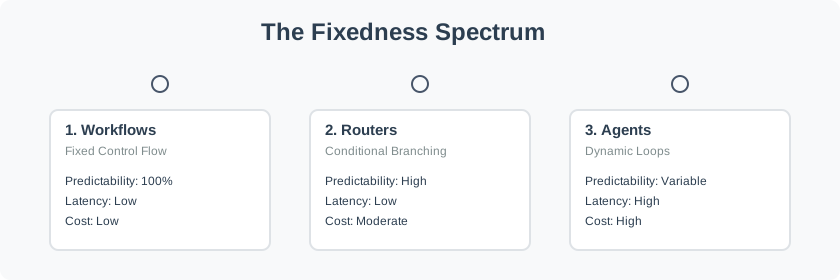
Autonomy is not a binary choice, but a continuum known as the Fixedness Spectrum. On the left end of the spectrum, control flow is completely locked in application code. On the right, control flow is dynamically determined by the language model at runtime. Selecting where a system should sit on this spectrum is a critical architectural decision.

Three Architectural Patterns
The Fixedness Spectrum is divided into three distinct design patterns, each suited to different problem profiles:
1. Workflows (Highly Fixed)
A workflow is a deterministic sequence of operations defined entirely in code. The application execution path is fixed. The language model is restricted to parsing inputs (e.g., extracting fields from a document) or generating text at predefined stages.
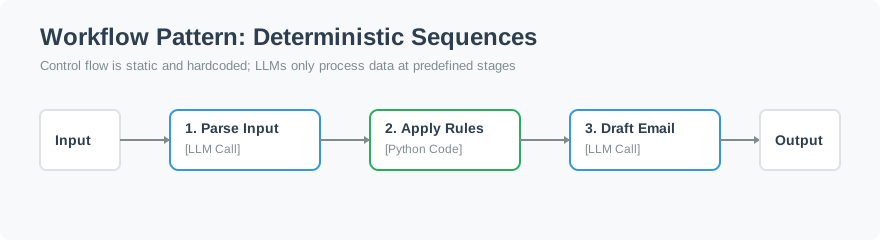
- Path: Step A Step B Step C (always constant).
- Characteristics: High predictability, low latency, low API costs, simple to test.
- Use Case: Actions with clear, unvarying business rules, such as checking order shipment details and email confirmation.
2. Routers (Conditional Routing)
A router pattern uses a classification component (often a small, fast language model or a heuristic rule engine) to inspect incoming text and route the request to a pre-defined, deterministic workflow.
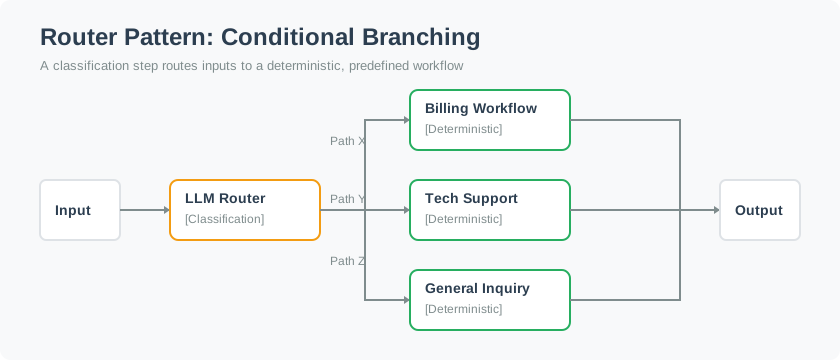
- Path: Input Router Select workflow X, Y, or Z Execute.
- Characteristics: High predictability post-routing, low-to-moderate latency, moderate API costs.
- Use Case: Support desks sorting customer requests into distinct categories (e.g., billing disputes, technical issues, return requests).
3. Agents (Highly Autonomous)
An agent is given a set of tool descriptions (functions) and an open-ended goal. The language model determines the sequence of tool executions dynamically. At each turn, it reviews previous outputs to decide the next step, terminating only when its goal is achieved.
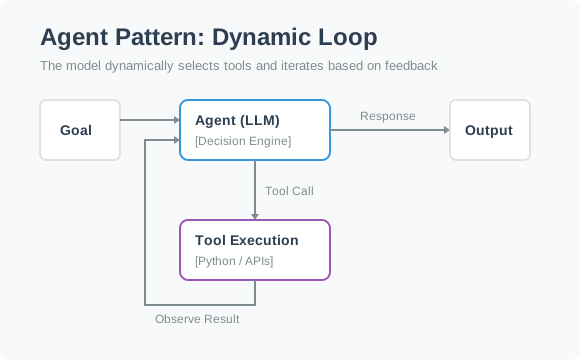
- Path: Input Tool A Observe output Tool B Observe output Terminate.
- Characteristics: High flexibility, nondeterministic execution path, high latency, high API costs.
- Use Case: Complex, multi-step queries where the exact sequence of lookups depends on runtime information (e.g., investigating a damaged item delivery involving checking orders, looking up warranty policies, and deciding compensation).
The Principle of Parsimony
[!IMPORTANT] The Rule of Parsimony: Use the least autonomous pattern that satisfies the system requirements.
If a business task can be executed using a workflow or a simple router, implementing an agent introduces unnecessary complexity. Autonomy should be reserved solely for tasks where the sequence of operations cannot be predicted before runtime.
In the next lesson, we will implement the engine of autonomous systems: a bare-metal Python agent loop.