
Component-Level Evaluation Scope
The Principle of Component Isolation
In complex agentic architectures, testing the entire system end-to-end for every minor prompt tweak is highly inefficient. E2E tests suffer from compounding nondeterminism, high token costs, and long execution times.
To maintain engineering velocity, developers must apply the software engineering principle of Component Isolation.
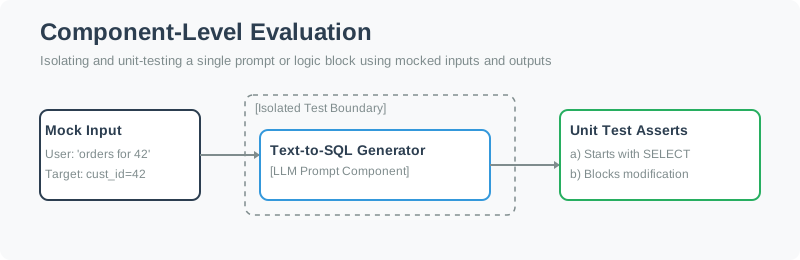
Component-level evaluation isolates a single module - such as a classification prompt, a key-value extractor, or a Text-to-SQL query generator - and evaluates its performance independently. We stub or mock all surrounding inputs and outputs, removing the rest of the agentic loop from the test execution.
Designing a Component Test Harness
To test a single component, we construct a test harness consisting of:
- Mock Inputs: A set of hardcoded natural language inputs or intermediate execution states.
- The Component under Test: The prompt, schema matching logic, or LLM completion call.
- Programmatic Assertions: Lightweight, code-based verification checks that assert on structural, safety, or semantic constraints of the output.

By isolating the component, we achieve:
- Low Latency: Tests complete in milliseconds or single-digit seconds, rather than running multi-turn loops.
- Deterministic Boundaries: Failures can be directly traced to the isolated module rather than upstream context pollution or downstream tool errors.
- Cost Control: A component-level test can be run hundreds of times during prompt tuning for a fraction of the cost of a single E2E trace.
Interactive Playground: Text-to-SQL Unit Tests
In this exercise, you will complete the assertion logic for a Text-to-SQL validation test.
We have a Text-to-SQL module that translates user queries into SQLite SELECT statements. You must implement the programmatic asserts in validate_query_assertions to ensure the generated SQL:
- Starts with the
SELECTcommand. - References the correct database table (
orders). - Includes the target customer ID filter (
cust_id). - Explicitly blocks modifying commands (
INSERT,DELETE,UPDATE,DROP,ALTER).
Run the playground to see the initial test suite failures, then implement the missing assertions to make all test cases pass.
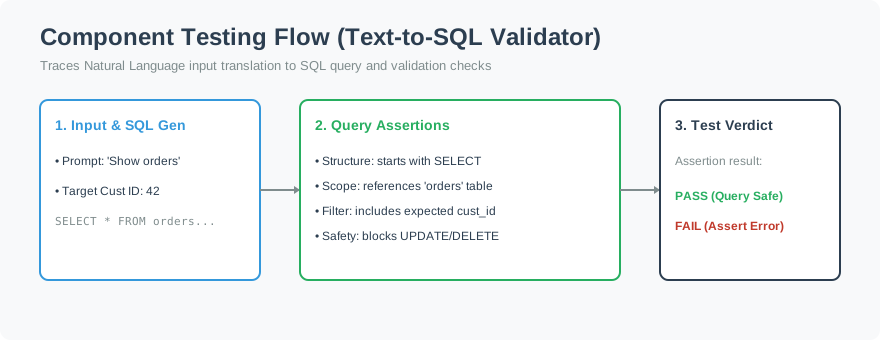
Exposing LLM outputs directly to execution layers requires programmatic safety bounds. Rather than testing the entire agent loop, isolating the Text-to-SQL generator into a component harness allows us to evaluate query formatting, table matching, and security safety with rapid feedback loops.