
The Core Loop: Bare-Metal Implementation
Mechanics of the Execution Loop
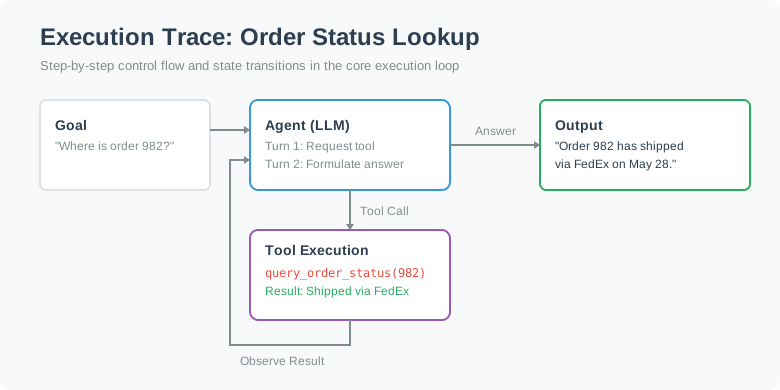
At the core of any autonomous agent lies a fundamental programming construct: a state-accumulation execution loop. Rather than delegating control flow to complex third-party abstractions, developers can implement agents using standard loops and conditional branching.
The execution pattern follows four distinct phases:
- Observe: Read the initial user request and the accumulated historical context of the conversation.
- Decide: Query the language model with the context. The model returns either a conversational answer or a structured request to execute a tool.
- Act: If a tool call is requested, parse the arguments, run the corresponding local function, and capture the output.
- Record: Append both the model's request and the execution results back into the conversation history, and return to step 1.
Turn Constraints and Termination Guards
Because execution cycles depend on nondeterministic outputs, agents are susceptible to infinite execution loops. For example, if a tool returns an error message, the model may repeatedly attempt to query the same tool with identical parameters.
[!WARNING] A hard termination guard is mandatory in production.
Without an explicit limit on iterations (turns), the application can consume excessive tokens, incur high API costs, and deplete computing resources. Standard implementations enforce a maximum execution threshold of 5 to 10 turns before forcing a programmatic escalation or termination.
Bare-Metal Python Implementation
The following playground implements a bare-metal execution loop using standard Python constructs.
The script creates an in-memory SQLite database representing customer transactions, defines a query tool with a JSON schema signature, and executes a while loop to resolve a customer tracking request. The language model requests database lookups, which are executed locally within the playground.

Structural Decoupling
Reviewing the loop implementation highlights two architectural patterns:
- Decoupling Reasoning and Action: The language model only emits a string requesting an action. It has no mechanism to execute the database query itself. The actual database execution happens strictly within the application environment. This preserves control boundaries.
- State Accumulation: The outcomes of function executions must be appended to the conversation history message list before the next turn starts. This history is what provides the stateless model with short-term context memory.
In the next module, we analyze the core mechanics of tools, comparing text search retrieval models with database query generation.