
Structured Retrieval: API Abstractions (REST)
The Vulnerability of Text-to-SQL
Exposing raw SQL database tools directly to language models (often referred to as Text-to-SQL) is highly flexible but introduces severe production trade-offs and safety risks:
- SQL Injection: Prompt injection attacks can hijack the model's instructions and force it to execute malicious SELECT statements to read sensitive database records or bypass access controls.
- Unoptimized Queries: Autonomous models lack an understanding of query execution plans. They can easily write complex joins or table scans that lock tables, exhaust database resources, or deplete connection pools.
- Tight Schema Coupling: Exposing table schemas directly to the LLM couples the model to the physical database design. Any database modification—such as renaming a column, migrating a table, or splitting a service—will immediately break the agent's prompts and few-shot examples.
Exposing APIs as Tools (Data Access Layer)
To secure and stabilize enterprise applications, database access must be isolated behind a Data Access Layer. Under this pattern, instead of exposing a raw database connection, you wrap database operations inside parameterized API endpoints (such as GET /api/orders/{id}) and expose those APIs to the model as tools.
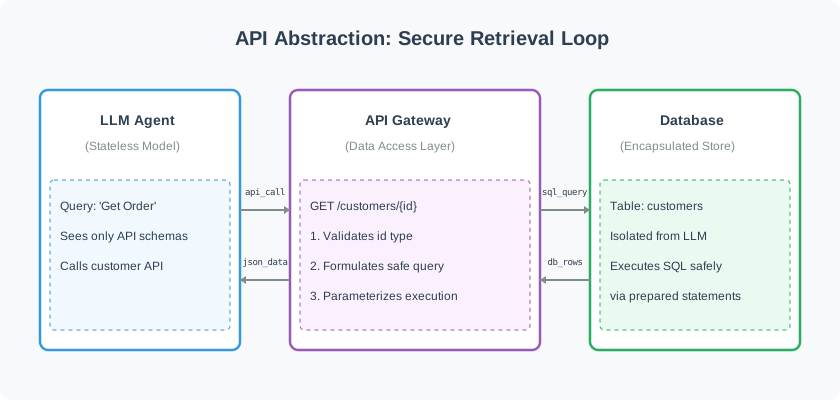

- Input Validation: The model is restricted to passing arguments (like integers or keys). The application code parses, validates, and parameterizes these inputs on the server before querying the database, eliminating SQL injection.
- Encapsulation: The underlying physical schema remains hidden. If table structures change, only the backend API execution code needs to be modified. The tools' JSON schema parameters and model prompts remain unchanged.
- Safeguards: Traditional web API safeguards—such as authorization checks, rate-limiting, query optimization, and response caching—can be directly enforced at the API layer.
Interactive Playground: Exposing REST Tools
The following playground simulates an API Gateway. Rather than letting the model write raw SQL, we expose two parameterized REST API endpoints:
get_customer_details(customer_id)(GET/api/customers/{id})get_order_details(order_id)(GET/api/orders/{id})
The backend database is encapsulated; only the mock API client endpoints are registered as tools. The model must call these endpoints sequentially to resolve customer requests.
Observe how the model handles the multi-turn retrieval:
- First, it calls
get_order_details(order_id=101)and learns that the order belongs tocustomer_id: 1and has a status of "Delivered". - Knowing that the customer ID is 1, it calls
get_customer_details(customer_id=1)to resolve the name ("Alice Smith"). - Finally, it compiles the retrieved JSON states into a cohesive response.
By wrapping database access inside parameterized APIs, the system secures backend assets while retaining the agent's capability to traverse relational paths.